The defeat of the 710 extension: How the good guys won; Pasadena Star News op ed by Larry Wilson, Nov. 1, 2023

I don’t doubt that as part of the ongoing current saga that is the cities of the San Gabriel Valley getting, as the church ladies so aptly say, right with God about their hideous longtime support of the 710 Freeway extension that happily never happened, the $200,000 the Pasadena City Council allocated this week to compile a history of the dismal failure will be more or less well-spent.

From 1965 on, about 1,500 buildings and homes were demolished north from the El Sereno neighborhood of Los Angeles into South Pasadena and Pasadena, and some 4,000 people were displaced from their residences.

Plenty of local cities fully bought into the Caltrans nonsense about the need for the freeway, but the great irony has always been that its most adamant local proselytizer, Alhambra, didn’t lose any housing or neighborhoods at all.

And the very fact that Pasadena City Hall, unlike all the rest of the area cities, actually built what we now know as the 710 stub, a mini-freeway that goes two absurd off-ramps — Del Mar and California — south from the 210 is a reminder of what many people have conveniently forgotten: For decades, the majority of the Pasadena City Council, now so proudly and valiantly anti-710, so house-proud for being so, was, next to the denizens of Alhambra City Hall, the greatest supporter of the stupid idea.

It was redevelopment time around the halls of power in the Crown City, especially in the early 1970s, when what we now know as Old Pasadena was very nearly demolished to build corporate headquarters like the former Parsons tower on the west and the former Pacific Bell building on its east.

The men of the powerful Pasadena Redevelopment Agency and a private group of business burghers called, yes, Pasadena Now were behind the campaign to raze everything historical in sight and start over in order to become … what, downtown Glendale redux? Something like that. And the planned freeway extension providing yet another link to Los Angeles — one that, unlike the swell and sedate Pasadena Freeway, allowed truck traffic — very much fit into their plans.

I won’t say very much for my own political prognostications over the years except that I have been anti-710 extension since I was a teenager, and so I suppose it’s gratifying to have the entire world coming around to one’s own point of view. Well, not one’s own. I mean, I did turn the official opinion stance of this newspaper slowly around — like turning the Queen Mary — from one of “it’s good for business” support for the extension to one of preservationist, environmentalist opposition to it when I became editorial page editor in 1987. So that was something.

But the heavy lifting all along was done by little South Pasadena City Hall and by that city’s amazing citizen volunteers such as the great Joanne Nuckols, she of the Volvo station wagon with the No 710 license plate. Along with their allies to the north in Pasadena Heritage, led by Claire Bogaard and Sue Mossman, along with attorney Chris Sutton, it’s plucky South Pas that finally beat the stupid, neighborhood-destroying, city-splitting, diesel exhaust-belching truck route into submission, at a cost for literally decades of ignoring almost every other issue in their town, very much including the state of repair of its own streets and sidewalks.

Anyway, now that this Pasadena-commissioned report will come out, we’ll at some point have a tidy place in which to read all about the racial and class indignities that were wrought when the bulldozers took down the West Pasadena neighborhood to create what the Tournament of Roses calls The Pit — a staging place for Rose Parade entrants — and what the kids at Sequoyah School to its immediate south call Lake Sequoyah, because it fills up into an almost water-skiable pond after heavy rains.

My teenage opposition began when family friend Marian Schuster bought a sweet little half-timbered cottage on State Street after a divorce. As with Julia Child’s brown-shingled Craftsman childhood home, as with dozens of other examples of wonderful architecture in the neighborhood, soon enough Caltrans stole half her yard when it widened Pasadena Avenue, along with the parallel St. John, into what is essentially a substitute freeway. Look at it today on Google Maps, which literally calls the surface street the 710. And be glad that every once in a while the good people win.

Write the public editor at lwilson@scng.com.

Posted in Uncategorized | Tagged , , , , | Leave a comment

More Whistleblowing Plaintiffs like this needed at Cal-Trans!

Sound familiar? Paving projects a mile or two at a time without environmental review to camouflage what they were actually doing.  And remember the 405 Fwy. Carmageddon of closing the 405 between the San Fernando Valley and West Los Angeles because they wanted to widen a few miles of freeway, demolishing bridges and wreaking havoc? Still traffic, of course.

Thank you Ms. Ward-Waller for exposing Caltrans tricks.

“A Caltrans executive questioned a freeway expansion. Then she was demoted.”

For years, a California Department of Transportation executive, Jeanie Ward-Waller, said she asked tough questions about multimillion-dollar road projects at meetings where she was often the only woman. 

Male bosses criticized her for being too emotional or aggressive, she said in interviews with The Times over the last two weeks. But Ward-Waller swallowed it, seeing it as part of her job to push forward an agency undergoing seismic shifts.

This summer, as the deputy director of planning and modal programs, Ward-Waller began raising questions about a $280 million repaving project along a stretch of Interstate 80. Ward-Waller became increasingly concerned the project was surreptitiously widening 3½ miles of the freeway — at the same time top state officials were pledging to end traffic-inducing freeway expansions to help meet ambitious climate goals. 

Under state law, such projects require environmental review and public airing, but this plan had none of it, she said — and it tapped funds set aside for maintenance. It happened to be along the same 20-mile corridor of I-80 from West Sacramento through Davis where a partially federal funded freeway lane is being proposed.

The funding for that corridor was competitive to get, and Caltrans could lose it if the project was not done quickly, she said. 

She suspected the repavement project was intended to jump-start the corridor work by adding space for a new lane while bypassing the environmental analysis normally required by a freeway expansion.

In meeting after meeting, she raised concerns. But she said she was brushed off by transportation officials.

Finally, she complained to her supervisor, Caltrans’ Chief Deputy Director Mike Keever.

“I said, you know, ‘I feel like we’re lying to the public. We’re breaking laws. This is a huge concern to me and I also have major concerns about accountability,’” she recounted.

She said she told him she was thinking of filing a whistleblower complaint with the state auditor. A complaint could trigger an investigation. 

Weeks later, she said, Keever called her into the office across the street from the Capitol to inform her that she was terminated from her position, with no explanation. A letter reviewed by The Times shows she was placed on informal leave and offered a lesser role, as required by state rules, at reduced pay. 

“I was just totally shocked,” she said. “I didn’t think that I had like crossed a line or done anything wrong.”

Her attorney called her demotion an attempt to “chill whistleblowing content.”

“The message that Caltrans is sending to everybody else who has similar concerns within the department, is that there’s nobody too high to break down,” said her attorney, Christian Schreiber. 

Ward-Waller filed a whistleblower complaint, first reported by Politico, with the state auditor Sept. 15. It detailed her objections over the project that she had shared with Keever and accused the agency of retaliating against her for making them.

In the complaint, reviewed by The Times, she said Caltrans District 3, which covers the state capital and oversees the projects she complained about, is well known inside the agency “to bypass and bend these rules and others regularly when it suits them to build more, bigger and faster projects.” 

The auditor’s office will not confirm if the complaint was made.

Caltrans spokesperson Edward Barrera said in a statement: “Caltrans takes the allegations seriously and will cooperate with any independent investigation into these claims. In addition, Caltrans does not comment on personnel matters.”

The Times sent emails to Keever, Caltrans Director Tony Tavares and District 3 Director Amarjeet S. Benipal, and tried to reach them by phone, but did not get a response. 

The accusations comes at a prickly time for Caltrans, under pressure to carry out Gov. Gavin Newsom’s climate goals while also continuing to push ahead on planned road projects that some environmental advocates see as undermining those efforts.

Caltrans was created to build freeways. For decades those sprawling roads were seen as a sign of progress, even as they exacerbated economic burdens through a reliance on costly vehicles, undermined cleaner and cheaper public transit and divided communities, particularly Black and Latino ones.

The agency is now grappling with its legacy, under the pall of deeply rooted inequity and a warming planet. Transportation is the largest contributor to California’s greenhouse gas emissions and studies have shown adding lanes increases vehicle dependence, while doing little to reduce congestion. 

In a watershed moment last year, Caltrans dropped a $6 billion expansion of the 710 Freeway that environmental and social justice activists said would add to pollution in Long Beach and the surrounding area.

California Transportation Secretary Toks Omishakin told the Times last year the state will no longer add freeway lanes solely to allow more cars and trucks to use them. The new policy is to look toward alternatives such as bus lanes, transit and bicycle routes. 

But environmental advocates have complained that despite California’s official line, the $20-billion agency continues to push ahead on expansion projects — sometimes by lumping them into other smaller projects. 

“This is classic Caltrans,” said Stephen M. Wheeler, a professor urban planning and design at UC Davis, who has followed development along the I-80 corridor. “Caltrans has a long history of plowing ahead and widening roads without regard to various better policy alternatives. It has done that in many different ways, including by breaking projects up into small pieces, which makes it easier to get it approved and avoid public scrutiny. “

In Southern California, Streets for All founder Michael Schneider points to a series of auxiliary lanes less than a mile long that are being added to the 405 freeway. Those lanes, he said, add capacity but aren’t considered new lanes and don’t undergo environmental analysis.

Ward-Waller said in the complaint she believes District 3 has employed a playbook similar to the I-80 with other projects, including work along the Capital City freeway over the American River in Sacramento. 

There’s a culture of wanting to build more, and get it done quickly, despite the policy direction that sort of forces us to take a deeper look at the public benefits of those projects,” she said in an interview.

Ward-Waller said she felt there was a general frustration with female leaders pushing for change, some who came into the agency like her, looking to support environmental or social justice goals. 

About three quarters of the 22,000 person agency is male and many she came into contact with were career employees who have been with the agency for decades. 

“There’s a culture of patriarchy there,” she said. “Being in meetings with lots of men who don’t hesitate to speak strongly or talk over each other or kind of bully each other … I would try to hold my own in those meetings. And I would not not allow myself to be talked over or cowed by that kind of behavior. But then, the criticism that I would then get from people above me is, ‘Oh, you’re too aggressive or you’re too emotional, or you got flustered.’”

Martin Greenstein, a spokesman for the California State Transportation Agency, which oversees the state’s roads, trains and water transportation systems, did not address Ward-Waller’s complaint, but defended Caltrans. He said California has been moving away from expanding freeways to create a “cleaner, safer, more connected and equitable transportation system.”

“Caltrans has been a key part of that transformation, representing a major paradigm shift from a focus on building highways to a people-focused department advancing more climate-friendly, multimodal options for all Californians,” he said in an emailed statement. “The department has undergone major changes in a short amount of time, and it has been a willing partner and is making progress in this transition.”

Some former employees said trying to shed its decades-long mission to erect freeways, once a symbol of California’s progress, has created tension inside the agency. 

It’s an organization that traditionally only builds highways and it’s really hard to shift into other types of transportation when the culture is one that says we have to do things the way we have always done them,” said a former Caltrans manager who worked on climate change in the agency. The person declined to be identified because they still work in the industry.

“Her [Ward-Waller’s] reassignment was a major blow for those in the department that are committed to this type of change.” 

Inside the agency, Ward-Waller, a former policy director of the California Bicyle Coalition and an engineer by training, sought to move the agency toward larger climate goals. She focused on getting high-profile projects funded and under construction, including the I-80 corridor project intended to relieve congestion. That proposal was still going through environmental analysis but sought to add managed lanes that are meant to ease congestion, such as bus, carpool or toll lanes. 

With an $86-million federal grant, the agency was under pressure to get the project moving, she said. When she and her team learned of the corresponding repavement project, she suspected the agency was dicing up the work to speed the projects along and skirt scrutiny. 

“I was specifically raising concerns about bending, potentially breaking the law,” Ward Waller said in an interview. “The concerns that I was raising were pretty typically just ignored.”

California Assemblywoman Laura Friedman (D-Glendale) has been pushing legislation that would require that state-funded planning and infrastructure projects reflect the state’s climate goals. She’s afraid the state is only giving lip-service to those goals. 

A recent analysis by the Natural Resources Defense Council of more than 4,000 state-funded transportation projects found that 19% actually reduce driving. Of the $22.4 billion dedicated to those projects, 10% went toward the expansion of roads. 

Regulators say Californians must cut mileage by 25% below 2019 levels if the state is to meet emission targets. 

Friedman said she is “committed to making sure CalTrans abides by state guidelines. Those guidelines exist for a reason and are important to meet the state’s environmental goals.” 

Next month, she plans on calling legislative hearings to learn whether California is investing in infrastructure that aligns with its goals. 

“It would be lovely if [Ward-Waller] was blowing the whistle off something that was really uncommon or egregious, but my guess is it’s relatively common in our field,” said Beth Osborne, director of the advocacy group Transportation for America.

Over the next five years, the U.S. Department of Transportation will spend $350 billion on highways as part of the infrastructure bill passed last year. 

“It is important that U.S. DOT play a role and monitoring this much better,” she said. “It has always been my frustration as a transportation policy person to see some of the greatest resistance to change comes from the people who claim to be champions of the environment.”

LA Times, Oct. 13, 2023, “A Caltrans executive questioned a freeway expansion. Then she was demoted”

Tagged , , , , | Leave a comment

If the freeway is dead, why is it still on Map Apps?

The Ghost of Dead 710 Extension in Pasadena Haunts Map Apps, Pasadena Star News, Nov. 28, 2022

Posted in Uncategorized | Tagged , , | Leave a comment

710 is DOA

Cal Trans to Relinquish 710 Stub to Pasadena, Coloradoblvd.net, May 7, 2022

LA Metro has Scrapped its 710 Freeway Widening Plan: LAist, May 27, 2022

710 Freeway Expansion Won’t Happen as LA Metro opts for Alternatives, Pasadena Star News, May 26, 2022:

The widening of a 19-mile stretch of the 710 Freeway from East Los Angeles to Long Beach was rejected by Los Angeles County’s transit agency on Thursday, putting an end to a contentious project in the works since 2005.

LA Metro spent $60 million studying and planning the $6 billion project for 17 years but on Thursday the transit agency reversed course, selecting the “no build” alternative and closing out the environmental impact report.

Eliminating widening was a major shift from a plan approved by its board in March 2018 to add general freeway lanes and truck-only lanes that would’ve required the destruction of hundreds of freeway-adjacent homes and businesses.

“We are no longer going to widen the freeway,” announced Janice Hahn, the LA Metro board member and Los Angeles County supervisor who initiated the motion approved today by a vote of 10-0. “We are no longer going to wipe out homes and neighborhoods for a freeway project.”

The action was seen as a victory for southeast county cities straddling the congested 710 corridor, including Commerce, Bell, Cudahy, Downey, Lynwood, Paramount, Carson and Long Beach, which opposed the expansion.

These cities, along with environmental justice groups, pointed to populations dominated by people of color receiving the burden of diesel pollution from trucks on the freeway and nearby roadways.

Microscopic tailpipe particles cause respiratory diseases, including asthma and lung cancer, public health effects well documented by numerous health studies. By increasing lanes, the air pollution burden would grow, opponents said. Early on, plans called for the widened freeway to have 10 general purpose lanes and four freight-movement lanes. Widening plans would have taken at least 100 homes, and displaced nearly 440 people and 160 businesses, according to environmental reports.

“It is important that we remove freeway widening from this project,” said Commerce Mayor Oralia Rebollo, at the board meeting before the vote. She said widening would have taken 50 homes in Commerce. “We need clean, zero-emission improvements, such as zero-emission truck programs.”

Long Beach Mayor Robert Garcia said a new approach is needed. “This is a great way of moving forward. We know that widening freeways doesn’t address the challenges we face.”

The “no build” choice is a way to end plans for widening, but it doesn’t end the possibility of future projects along the south 710 corridor. In fact, the Gateway Cities Council of Governments is putting together a list of projects that will come before the LA Metro Board next month.

“We can’t just talk about ‘no build.’ We have to talk about doing something,” Hahn said.

For example, the board voted to redirect the $750 million — set aside by Metro from sales tax monies — to less invasive improvements, such as a new Florence Avenue interchange in Bell with a pedestrian and bikeway portion, Hahn said.

Other improvements being considered include: money for zero-emission trucks leaving the twin ports of Los Angeles and Long Beach; higher freeway sound walls; air filtration systems in nearby schools; a regional light-rail project connecting the 710 cities; moving freight onto rail cars and off the freeways; and safer streets with more bikeways.

Part of the original project included improvements to the aging freeway’s on-ramps and off-ramps. “This motion absolutely does not prohibit projects like on- and off-ramp safety improvements. Some of these interchanges do need to be improved,” Hahn wrote in an emailed response to questions.

Additional dollars for alternative projects — which could cost upwards of $2 million — would have to be awarded from state and federal sources, Hahn said.

The beginning of the end for the 710 Freeway widening project began in 2021 when both the U.S. Environmental Protection Agency and Caltrans opposed the project. The EPA said adding freeway lanes would increase air pollution, not meet federal air quality requirements and was not a cure for gridlock. Caltrans said the project did not fit with its overall goals and standards.

Opposition from federal and state agencies meant the project would have no chance of receiving state or federal dollars to make up the large funding gap. Aligning alternative projects with these agencies’ objectives would increase the possibility of receiving funding, Metro said.

Members of Communities for a Better Environment, East Yard Communities for Environmental Justice, Earthjustice and the Long Beach Alliance for Children with Asthma have been fighting the project for years, suggesting alternatives that address congestion, air pollution and safety.

Lawyers for the Natural Resources Defense Council and the umbrella group, Coalition for Environmental Health and Justice, told the board they were concerned that future projects would be approved without consulting with a committee made up of residents and elected officials from 710 corridor cities.

“Even though you are rightly backing away from freeway expansion, these communities are still impacted by freeway congestion. You need to rebuild trust,” said Chris Chavez, deputy policy director for the Coalition For Clean Air.

Hahn was asked if nearly two decades of planning and reports and $60 million spent on a project that never got built was a waste of time and money.

“It is frustrating to be in this position, but it is an opportunity to learn from our past,” she responded.

Posted in Uncategorized | Tagged , , | Leave a comment

Final End of Freeway Threat, Stub Development Help for Pasadena, Relief for Tenants, Non-Profits & Post Freeway Actions All Included

For Immediate Release

Portantino’s Comprehensive 710 Corridor Bill Signed by Governor

                                                                                                 Oct 13, 2019

Sacramento, California Senator Anthony J. Portantino (D- La Cañada Flintridge) has proudly announced that SB 7 has been signed by Governor Newsom.  This final legislative outcome is the culmination of over 20 years of dedication the Senator brought to fighting the 710 freeway and to helping stakeholders in the 710 corridor.  It follows through on a promise that Senator Portantino made to activists, non-profits, and tenants in the 710 region when he negotiated the end of the 710 tunnel threat in December of 2016. Today, the Senator can confidently say that he kept his promise and all threat of a 710 freeway has been silenced.  The Governor appropriately signed SB 7 after other bills dealing with the corridor.  Under California law, the last bill signed by the Governor supersedes other legislative actions on the same specific issues in the same section of the government code.  SB 7 is cemented in law as the final and definitive action on the 710 freeway.

 Timing became a critical conclusion because in the final week of the legislative session, amendments were proposed that would dramatically interfere with the City of Pasadena’s plans to develop the left-over freeway stubs.  Senator Portantino subsequently negotiated with Caltrans language that solved the Pasadena issue, inserted these amendments into SB 7, making it the only complete and comprehensive fix for the 710 corridor on the Governor’s desk. Not only does SB 7 remove the threat of the 710 freeway from ever being built it helps facilitate solutions and alternatives in the corridor, including Pasadena’s plans to develop the leftover stubs and legislative help for the nonprofits and low-income tenants.

“I am very grateful to the Brown and Newsom Administrations for helping to define our three-year plan to terminate the 710 freeway and for negotiating the final amendments to make it happen. Generations who have been fighting this freeway can now rest in peace knowing that they made this day happen and that the 710 freeway will never be completed.  Many people worked collaboratively to get us to this place, giving moral support for those of us in office and providing the runway to let this 60-year-old plane land,” commented Senator Portantino.

For decades, many political leaders shied away from the 710 issue or ardently worked to complete this misguided transportation and financial boondoggle, but not Senator Portantino.  In 1998, at the very beginning of his political career he has been a consistent and strong opponent of the freeway’s completion.  Senator Portantino promised residents that upon his election to the State Senate he would make ending the tunnel threat a top priority and he followed through on that commitment. 

“We are extremely grateful to our Senator for putting the final nail in the 710 tunnel’s coffin.  He has been by our side for two decades; he kept our group calm over these last three years, and he followed through on his promise to have a legislative solution to compliment Metro’s action and the certified EIR.  Now that SB 7 is signed we can all finally sigh in relief,” commented Claire Bogaard, No 710 Action Committee.

In addition to ending the tunnel threat, SB 7 helps the non-profit tenants in the 710 corridor purchase their properties in a fiscally prudent manner; something long sought by the Pasadena Ronald McDonald House, Arlington Gardens, Cottage Co-op Nursery and Sequoyah School.  During the legislative session, multiple representatives from the non-profits traveled to Sacramento several times offering testimony in support of SB 7.

“We are over the moon that we now have the ability to purchase our properties and to keep them serving our community.  Our Senator heard our needs and responded in earnest to help us.  We join in the celebration now that this important bill has been signed,” commented Megan Foker, Pasadena Ronald McDonald House.

Pasadena Mayor Terry Tornek participated in the final negotiations ensuring that SB 7 had strong provisions for ending the freeway threat and that Pasadena has the flexibility in the future to negotiate for the freeway stubs not needed by the obsolete freeway plan. 

“It is a new day in Pasadena now that the 710 freeway is history.  SB 7 ensures that outcome and helps all of us turn our attention to solving local traffic needs, raising the funding necessary to purchase the non-profit properties, and brings some relief to tenants in Caltrans’ affordable rent program.  For as long as I can remember, Senator Portantino has been dogged in his efforts to fight the 710-tunnel threat and he fulfilled his promise,” added Mayor Tornek.

The 710 corridor has been a long-time divisive issue for the region. While the freeway’s formal demise has garnered the most attention, SB7 does much more. It protects non-profits, low-income tenants, and is the only bill that actually helps Pasadena develop the no longer needed freeway stubs.

 “I am so grateful to the freeway fighters from South Pasadena who in 1998 took me on a tour of the 710 corridor and shared their struggle with me. The Avenue 64 & El Sereno activists and leaders from Pasadena, Glendale, La Cañada Flintridge and Sierra Madre broadened the coalition to create an immovable force to pull the San Gabriel Valley into a new and positive direction.  In the end, many of those who supported the 710 for decades also worked collaboratively to bring us to this point in time to help solve local transportation needs.  I am also very grateful for the timing of the Governor’s action so Pasadena can develop the freeway stubs in the city.  I’m glad that Pasadena brought its significant concerns to the forefront and I was able amend SB 7 to help this great city,” concluded Senator Portantino.

#####


Website of Senator Anthony J. Portantino: http://sd25.senate.ca.gov/


Posted in Uncategorized | Leave a comment

Historic moment: Alhambra works with South Pasadena and Pasadena to say goodbye to the 710 freeway connection – and request money!

Now that Metro/Caltrans has chosen #4 out of the 5 possibilities for the 710 freeway, it’s time to dole out some of the tax monies set aside from Measure R (approximately $25/year per LA County resident since 2009). to synchronize lights, widen streets and do other street improvement projects. Alhambra has jumped in on the request with South Pasadena and Pasadena to get additional money; in particular, in a letter signed by the three mayors, Alhambra is requesting $100M to do something with the 710 stub  Valley and the 10 freeway. (Tri-Cities Early Action Projects Letter – 11-26-18)

Unlike Pasadena and other cities, that for several years have been  considering solutions and design plans for its stub, Alhambra officials have not publicly discussed alternatives to the freeway tunnel they had their hearts set on for 60 years.  The current Mayor of Alhambra Jeff Maloney told the Alhambra Source, “We need to do a lot of research and studying of the issue,” (Nov. 29, 2018, Alhambra Source “The 710 Tunnel is Officially Off the Table”), but is considering a green belt in place of the asphalt on- and offramps  leading from and to the 10 freeway from Valley Boulevard.  Alhambra is requesting $100M from Metro/CalTrans to  help fund such a project.

November 28, 2018 

Los Angeles County Metropolitan Transportation Authority 

One Gateway Plaza 

Los Angeles, CA 90012-2952 

RE: State Route 710 Early Action Projects Funding Allocation 

Dear Chair Kuehl and Metro Board of Directors, 

The cities of Alhambra, Pasadena, and South Pasadena (Cities) commend the Los Angeles County Metropolitan Transportation Authority (Metro) Board of Directors’ decision to allocate the remaining Measure R funding dedicated to the State Route 710 (SR-710) towards the implementation of “corrective measures to contain the regional traffic on the freeway system and minimize impacts on the local street network.” In anticipation of the Metro Board approving the initial list of State Route 710 (SR-710) Early Action Projects (EAPs) on December 6, 2018, the Cities would like to demonstrate their united support for three cross-jurisdictional projects that will provide significant benefits to the San Gabriel Valley. These projects include: 

1. Removal of the SR-710 freeway stub in Alhambra between the I-10 and Valley Boulevard; 

2. Completion of the SR-110 Hookramp Project in the City of South Pasadena; and 

3. Removal of the SR-710 freeway stub in Pasadena between the I-210 and California Boulevard. 

During the November 15, 2018, Metro Ad Hoc Congestion, Highway, and Roads Committee Meeting, the Committee recommended funding for the SR-110 Hookramp Project ($38 million) and SR-710 North of I-10 Termination Project ($100 million). In order to optimize the success of these two projects funding for the Pasadena I-210 Ramp Modifications Project should also be provided. It is through the combination of these three projects that we can effectively divert regional traffic away from the corridor and minimize traffic congestion on local streets. 

If you have any questions or comments please feel free to contact Margaret Lin, Principal Management Analyst, at MLin@southpasadenaca.gov or (626)403-7236. 

Sincerely, 

Alhambra Mayor Pasadena Mayor South Pasadena Mayor

Jeffrey K. Maloney, Terry Tornek, Richard D. Schneider 

CC: Alhambra City Council 

Pasadena City Council 

South Pasadena City Council 

To see the letter: Tri-Cities Early Action Projects Letter – 11-26-18


IMG_0008

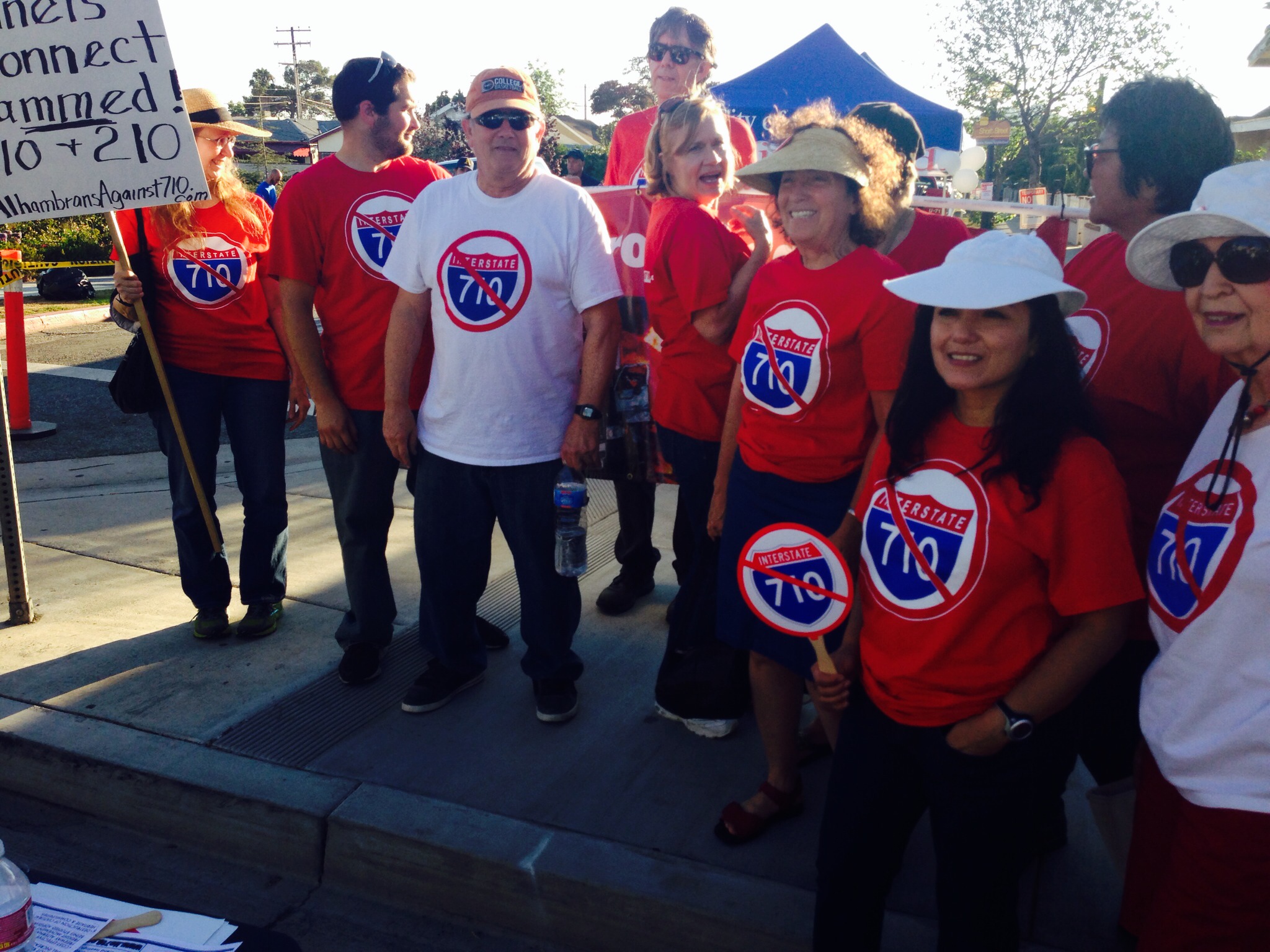
Some of the Alhambran group on 7-10-2014 at the City-sponsored “Close the Gap” day (when the City closed off Fremont for 1/2 day to push for the 710 freeway tunnel, causing major traffic on Fremont.)


Posted in Uncategorized | Leave a comment

No more 710 Freeway or Tunnel!

Caltrans Officially Kills 710 Extension Project After Decades Of Debate

https://losangeles.cbslocal.com/2018/11/28/710-freeway-extension-alhambra-south-pasadena/

PASADENA (CBSLA) — The 710 Freeway extension project is officially dead after six decades of debate over lengthening the busy interstate route from Alhambra to Pasadena. Caltrans announced Wednesday that it had finalized a report endorsing local street improvements instead of a freeway tunnel.

“After many years of discussion, the greater Pasadena, South Pasadena and Alhambra community can move forward with important local road and transit improvements to help more people get to where they’re going while keeping communities connected,” Caltrans Secretary Brian Annis said.

Annis joined a host of local officials in Pasadena to announce the certification of the final environmental impact report on the freeway gap, adopting the local street improvements in lieu of a tunnel that would have connected the Long Beach (710) Freeway with the Foothill (210) Freeway at a cost of more than $3 billion.

The adoption of the local-street alternative became all-but-inevitable last year when the Metro Board of Directors diverted $700 million in funding away from the tunnel proposal and applied it to area road projects. Other options that had been considered to close the freeway gap included a rapid-transit bus line, a light-rail line and a “no-build” option.

“I’m ecstatic that the EIR was finally signed, bringing closure to this six-decade 710 fight,” said Sen. Anthony Portantino, D-La Canada Flintridge. “Generations of neighbors on both sides of this issue passionately pushed their perspectives and now we can all turn our attentions to collaboratively solving local transportation needs. This removes the threat of the freeway and allows Caltrans to sell the balance of properties acquired to facilitate its construction.”

The possibility of a 710 extension has been on the table for decades, but has been thwarted by generations of opposition from some of the communities in its path, including South Pasadena. Caltrans began in the 1950s and 1960s buying empty lots, houses and apartments along the planned route of the surface freeway extension. But a series of lawsuits and opposition from some communities and activists has kept the project in perpetual limbo for decades.

Two years ago, Caltrans began the process of selling off the houses and apartments it owns along the corridor as part of its shift away from a surface freeway extension and toward a tunnel or other options.

The tunnel received a wave of momentum after county voters approved Measure R in 2008, a half-cent sales tax that raised $780 million for improvements along the 710 corridor, some of which has already been spent on studies and reports.

Some leaders of communities along the corridor, including Alhambra, had been in support of the tunnel as a viable alterative to relieve the extra congestion and air pollution caused by freeway traffic cutting through the surface streets. But other communities opposed it out of safety concerns over building the tunnel and with doubts that it would relieve congestion or reduce
air pollution in the area.

A Metro study concluded the tunnel would have carried 90,000 vehicles and removed 42,000 vehicles a day from local streets.

(© Copyright 2018 CBS Broadcasting Inc. All Rights Reserved. City News Service contributed to this report.)

Posted in Uncategorized | Leave a comment

Would a dual-bored tunnel under Emery Park’s 100 year old homes been damaged, too, with a 710 tunnel construction. Here’s indication based on what’s happening in Seattle.

TUESDAY 7, NOVEMBER 2017

Bertha may have dealt a blow to Seattle’s police museum

by Knute Berger

The Seattle Metropolitan Police Museum, one of the historic gems of Pioneer Square, has announced that it is closing and moving its collection due to safety concerns.

The museum, located near Third Avenue South and Jackson Street, is devoted to the history of the Seattle Police Department and the King County Sheriff’s Department.

The man in charge and the museum’s guiding spirit is SPD Officer Jim Ritter. He says he believes the building has become untenable for his museum due to ground settling and visible cracks that he suspects are due to Bertha and the waterfront tunnel project.

Ground settlement has been a big issue in Pioneer Square, much of which is built on landfill and former mudflats. The city had to contend with replacing a major sewer line on First Avenue due to settlement. Buildings near the Bertha tunnel boring machine rescue pit were also at risk. Other property owners have filed claims with the state over tunnel project-related damage.

SPD Officer Jim Ritter, head of the Seattle Metropolitan Police Museum.

Ritter says some of the building’s floorboards have rotted due to damage from a steam tunnel break. One of the museum board members put her high heel right through the rotten floorboards, he says. Some of the damage is very visible: The sidewalk outside is sloping. Cracks have appeared in the original 1909 plaster walls of the building, but also in newer drywall. One of the original brick walls appears to be bowing. Many of the doors that Ritter installed himself can no longer be closed properly.

All of this damage, he says, has occurred in the last 18 months to two years. Ritter emphasizes that he’s no engineer, but from a layperson’s perspective, he’s very concerned.

The building has survived several major earthquakes and Ritter can point to some old scars from the 1965 and 1949 Seattle earthquakes. Also, part of the facade collapsed during the 2001 Nisqually quake, but that was repaired and the building was deemed sound after that. Since there hasn’t been a major quake in the last 18 months, but tunnel and seawall work has taken place, “when you start looking, you can make a circumstantial case” for Bertha, he says.

The building is owned by the Samis Land Company, which owns 11 properties in Pioneer Square, according to Adam Hasson Samis’ director of real estate. Hasson says Samis has seen some damage at its other properties, but mostly cosmetic damage — some drywall cracking or stick door jams, “not anything dangerous,” he says. Samis has not yet filed any claims with WSDOT for tunnel-related damage. An engineer will inspect the museum’s space this week to determine whether there’s a true safety risk.

Ritter says Samis has been very good to the museum and gave them a break on rent that enabled them to afford the space. The museum was facing a rent increase, but Ritter says that’s not the main reason for the move. He wants to ensure the safety of the museum’s one-of-a-kind-collection and its patrons. All of SPD’s history could be gone if there were a major problem or collapse in a quake, he says. His opinion is informed by experience: The museum only has one document on exhibit dating from before 1889 because virtually all of the city’s police records were destroyed in the Great Seattle Fire.

Ritter says the extensive collection, which includes uniforms, records, photographs, badges, weapons and other artifacts, will be placed in storage, but that won’t be the end of the museum. He hopes to also put much of the collection online for researchers, and the museum has an extensive collection of police vehicles from the 1940s on that are shown off at public events and parades. The museum is financed through a payroll deduction plan of law enforcement officers at the city and county.

Whatever the reasons for the museum’s closure, it is not a happy occasion for local historians or police personnel. Ritter says the museum is valuable for new recruits who come to the city without any sense of local history. With the issues of police reform having taken center stage in recent years, the need to study and understand the history of law enforcement in Seattle is more important than ever. The closure of the museum and putting its collection into storage makes that a little harder.

Posted in Uncategorized | Leave a comment

Alhambra might have dodged a bullet!

Tolls or not, Seattle tunnel will push vehicles onto surface streets 

BY KIPP ROBERTSON
OCTOBER 27, 2017 AT 1:40 PM

Once the Alaskan Way Viaduct is no more, drivers will have to choose between and tunnel and surface streets. (WSDOT)

Punishing drivers who divert to Seattle’s surface streets once the new tunnel is in place would be a disservice to people who do so out of necessity.

RELATED: Tunneling machine completely disassembled

Seattle Councilmember Mike O’Brien proposed spending $200,000 in the next budget to study tolling Seattle’s surface streets. His reasoning is that drivers are going to avoid the tunnel to avoid the toll associated with it.

“Folks that are on 99 that are going to try to divert to get out of the tunnel, because they don’t want to pay that toll, do we have some sort of toll that says, ‘You are going to pay a toll one way or the other’? So if you are going to use the tunnel, just use it,” he said.

Downtown, and really all of Seattle, doesn’t have the capacity for additional cars. The director of Seattle Department of Transportation said so himself when he said the city couldn’t handle more vehicles. A toll to use surface streets, like congestion pricing in London, would be a method to keep the number of vehicles down.

But O’Brien’s comments are directed at people avoiding tolls. The proposal to make drivers pay “one way or the other” ignores the fact that many people use the Alaskan Way Viaduct to get in and out of downtown and Belltown, not just to avoid the area.

A study estimated that between 20,000 and 25,000 additional vehicles will be pushed onto I-5 and surface streets once the tunnel is open, depending on the toll “scenarios.” The Washington State Transportation Commission has not set toll rates for the tunnel. However, those estimates include all drivers diverting around the tunnel; not just the ones expected to avoid paying a few dollars. A spokesperson for the Washington State Department of Transportation confirmed as much.

Once the tunnel is in place and the viaduct is gone, drivers will not have mid-town exits, according to WSDOT spokesperson Ethan Bergerson. The tunnel will no longer have ramps to/from Seneca Street, Columbia Street, Western Avenue, or Elliott Avenue.

Demolition of the aging viaduct is expected to occur in early 2019. The tunnel is expected to open in the same time period.

The tunnel is more like an express lane through downtown, rather than into it. That means drivers who currently use the viaduct to get closer to their destination in downtown or Belltown will be forced to find an alternate route.

That alternative route will likely be an expanded Alaskan Way surface street, which will have more lanes and better access along the waterfront, Bergerson points out.

“The new tunnel will be just one of several transportation investments to the Seattle waterfront over the next several years, including the new Alaskan Way surface street with improved capacity and connections to downtown Seattle,” Bergerson wrote.

O’Brien says “places around the country” are having the difficult conversations about tolling congested areas. He reportedly said, “there aren’t very many tools that have been proven to work around the world, and I think it’s important that this be part of the conversation.”

But should we toll drivers who were forced to change their routes? Maybe the city council should keep digging through that toolbox.

Posted in Uncategorized | Leave a comment

Gov. Jerry Brown gets our signatures

In May, the Metropolitan Transit Authority voted to recommend to the California Department of Transportation a different alternative than building a tunnel to complete the 710 freeway. The unanimous vote essentially kills the 710 freeway project after a 60-year fight that divided the region. County Supervisors and local city leaders have begun in earnest to develop common interest projects that will meet local traffic issues, tapping into Measure R resources previously dedicated to the tunnel.

Senator Anthony Portantino is moving things right along, and met Governor Jerry Brown to deliver signatures in opposition to the 710 Freeway Tunnel.

“The demise of the 710 tunnel is a testament to grassroots activism in its finest form. I am so pleased to have seen MTA respond to these local efforts, first in stopping the threat of the tunnel, and now through the engagement of our local cities in moving into the future. Our region is certainly better served by this collaborative planning approach now that the tunnel threat is behind us,” concluded Portantino.

Read the press release here: Portantino Meets with Governor Brown Talks 710 Tunnel (Final)


Meanwhile, here’s what Barbara Messina has to say on the fate of her 710 pet project: Alhambra Source: The 710 Tunnel’s Fiercest Advocate Reckons with its Defeat. 


Portantino and Governor (3).jpg

Anthony Portantino delivered the scroll along with a book of additional
signatures to Governor Brown in his office last week.


Posted in Uncategorized | Leave a comment